Knit to fit, Fit to knit: I made a boo-boo. Twice
No matter if I publish a new pattern or not, needles have always been in my hands whenever I got a chance. One of those projects is a Brioche jumper. I wanted a fluffy jumper - top down, raglan construction with the yarn - wool & mohair held together. It had been in my head for sometime, in fact, for a couple of years. My initial plan was that I would publish a new pattern in early January 2025 or at the end of January the latest. Well, that didn’t happen. I managed to screw up spectacularly, not even once, Twice!
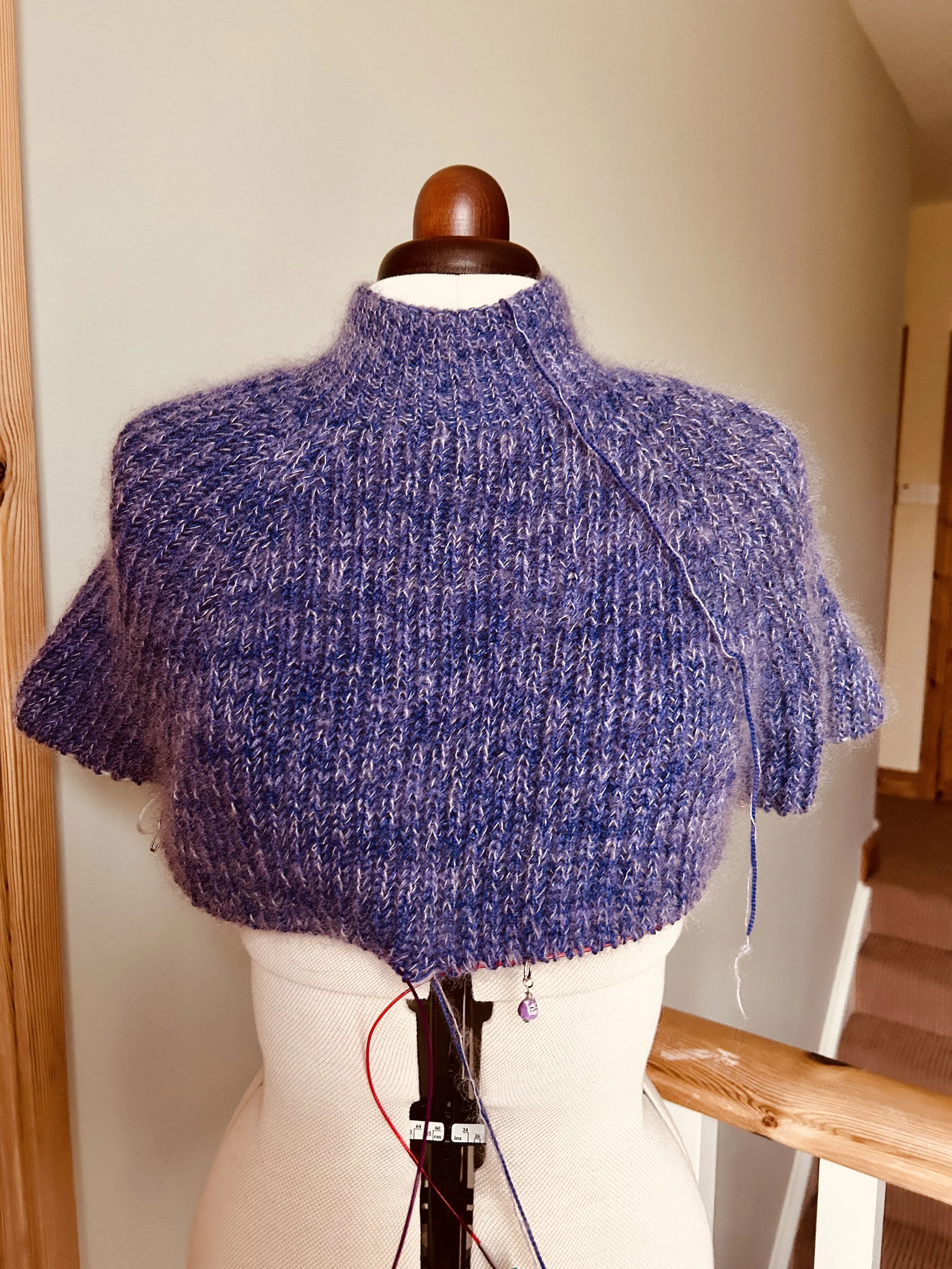
Little that I knew it would grow…
The First Froggging
First, I miscalculated the numbers. I knitted up to (down to) the sleeve division, and I had to frog the entire work. One of my superpowers (if I have one) is(was) that I can calculate numbers fast and quite accurately in my head. Now, it is no longer my superpower. What happened was “Perimenopause”. These days, I get brain fog from time to time. Now I must admit that I could get wildly off numbers. This is also due to my bad habit. I don’t know what other designers’ processes might be. Mine is far from an organised one. I’m often overwhelmed by the desire of making the one in my head as fast as I can. I cast on as soon as my swatch is done. The numbers are calculated in my head while the first sample is made. And then, I grade different sizes in excel sheet while making the second sample. I know it’s a doubly long process. I should start the process by getting the numbers first and then sampling it. Believe me. I tried. But I found myself casting on first before anything else again and again. I can’t help myself. I decided to accept my shortcomings a long time ago. So that is that. I guess I cannot do it this way anymore. My biological changes force me to adapt to different working approaches. Maybe it is a good thing.
The Second Frogging, Ouch!
Second, I was mistaken about the yarn info. When I teach knitting, I insist that my students do a couple of things in the process of knitting. One is swatching. I mean “swatching correctly,” which means not only to check the gauge numbers but to note the content of yarn and to make sure you know how the fabric behaves. Then, I didn’t do what I preach. I, too, skip the steps sometimes. Thinking that I knew about the yarn weight and materials so well, I skipped the most important step - checking the yarn content and making sure it’s suitable for the project. So it bit me in the backside eventually. I was so sure that the yarn was 100% non-treated wool. I didn’t check the label. It turned out that it is a sock yarn with super-wash wool. Do you know super-wash wool grows? Yes, it grows a lot! I didn’t check the label, and I trusted my memory, which is quite unreliable these days.
Just after knitting and measuring, it wouldn’t show you right away how much it had grown. When I pictured it and posted it all over social media, it was perfect! While it was hanging on a dress dummy for a few days, it grew and grew. The yoke ended up reaching my elbows. Briefly, I thought about keeping going with “it’s an oversized fit, so it will be all right at the end”. I could insist that it would be a design intention. But I didn’t like it. If I, the designer, don’t like the jumper, how can I expect anyone to like it? Hence, the second frogging.
By the time I frogged the second time, the exhaustion took over me. But I needed to come up with a way to salvage the yarn. I already have this sock yarn held together with mohair. Once you do it, it’s almost impossible to separate them. I had no choice but to use the yarn the way it was — mohair & wool held together. I fought really hard not to ditch this project in one of “oh-too-many” WIP bags.
Some might say that the mohair can prevent the paired yarn from growing. Yes and no. Mohair & silk themselves can grow over time vertically. However, it can also be affected by which yarn you combine with, the characteristics of the garment, and those of the knitting stitches. As I’m making an oversized, brioche one. It won’t help that much. The brioche stitch itself makes the stitches loose. When it comes to growing problems, the denser the fabric, the better to prevent from growing. I really wanted to keep the brioche texture for this. So I needed to figure out another way while keeping brioche stitches.
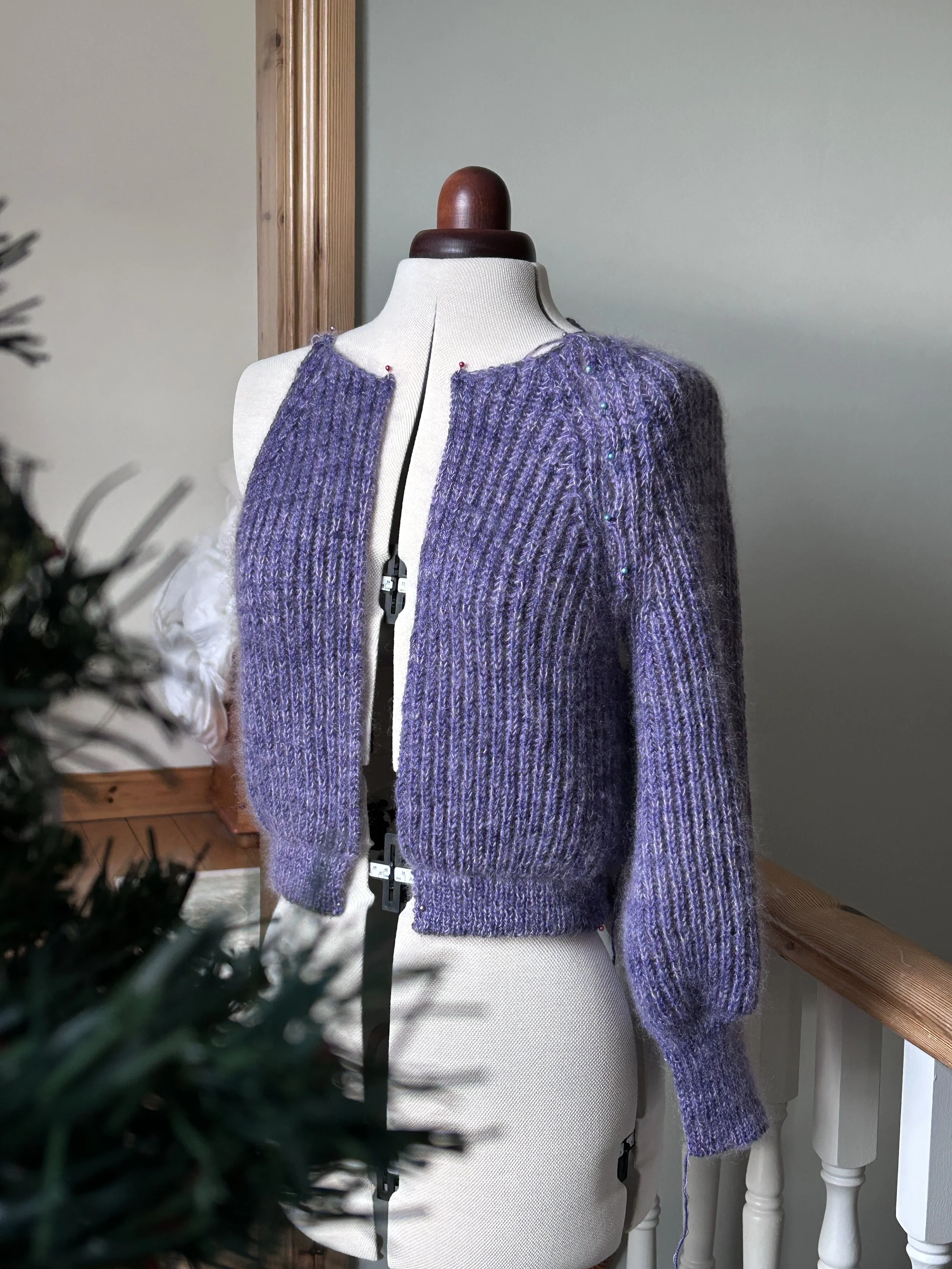
Changed the construction _ now it’s a cardigan.
Fortunately, there are several ways to counteract fabric growing. I thought this would be the perfect chance to share the method with crafty friends. Things happen for a reason.
Yes, change the Construction.
First, I changed the construction. It was top-down, no seam construction. Now I changed it to a bottom-up, flat construction. Seams in the garment can minimise changes in garment shape. I know many knitters prefer seamless construction. As a knitter, I’m the same. I don’t like weaving in ends. I just don’t have much patience for it. As a wearer of knitted garments, I prefer seamed ones. It will not change the shape much over the years.
(The jumper in the picture below was made in 2006. I’ve worn it like daily basis in every winter since then. It neither changed its shape nor required re-blocking. That is the beauty of seamed garment in knitting.)
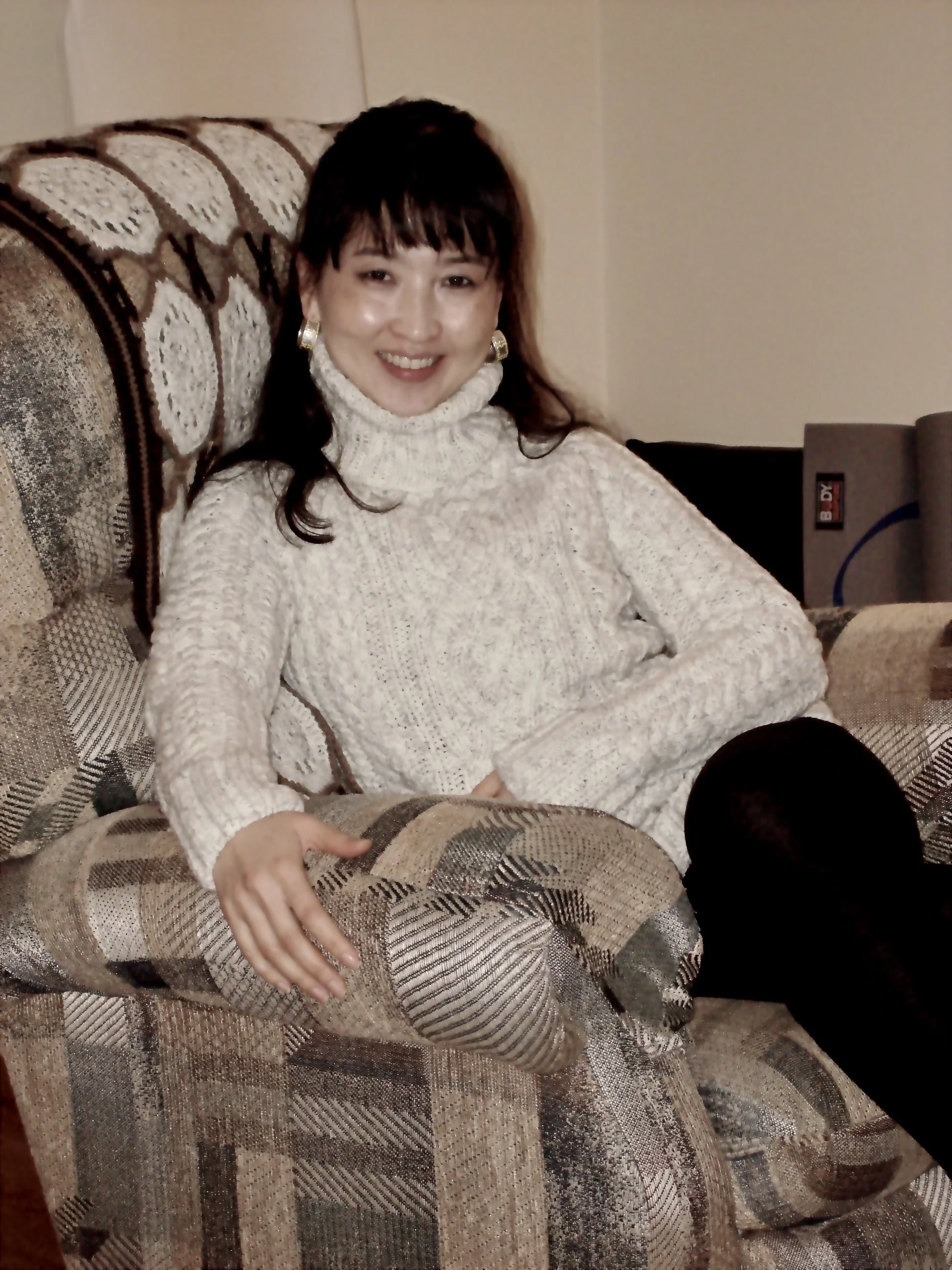
My beloved 20+ year-old jumper
From Jumper to Cardigan
Second, I also changed it to a cardigan. A cardigan itself can reinforce the garment’s shape as it has button bands in front. The bands could be a great anchor as well as the seams.
It’s been more than a month since the cardigan was hung on the dress dummy. It hasn’t grown. Happy days.
I named this design “Bouncy, Bouncy, Yeah!” -pun intended.
Damn, I need to weave in ends, though. - The End.
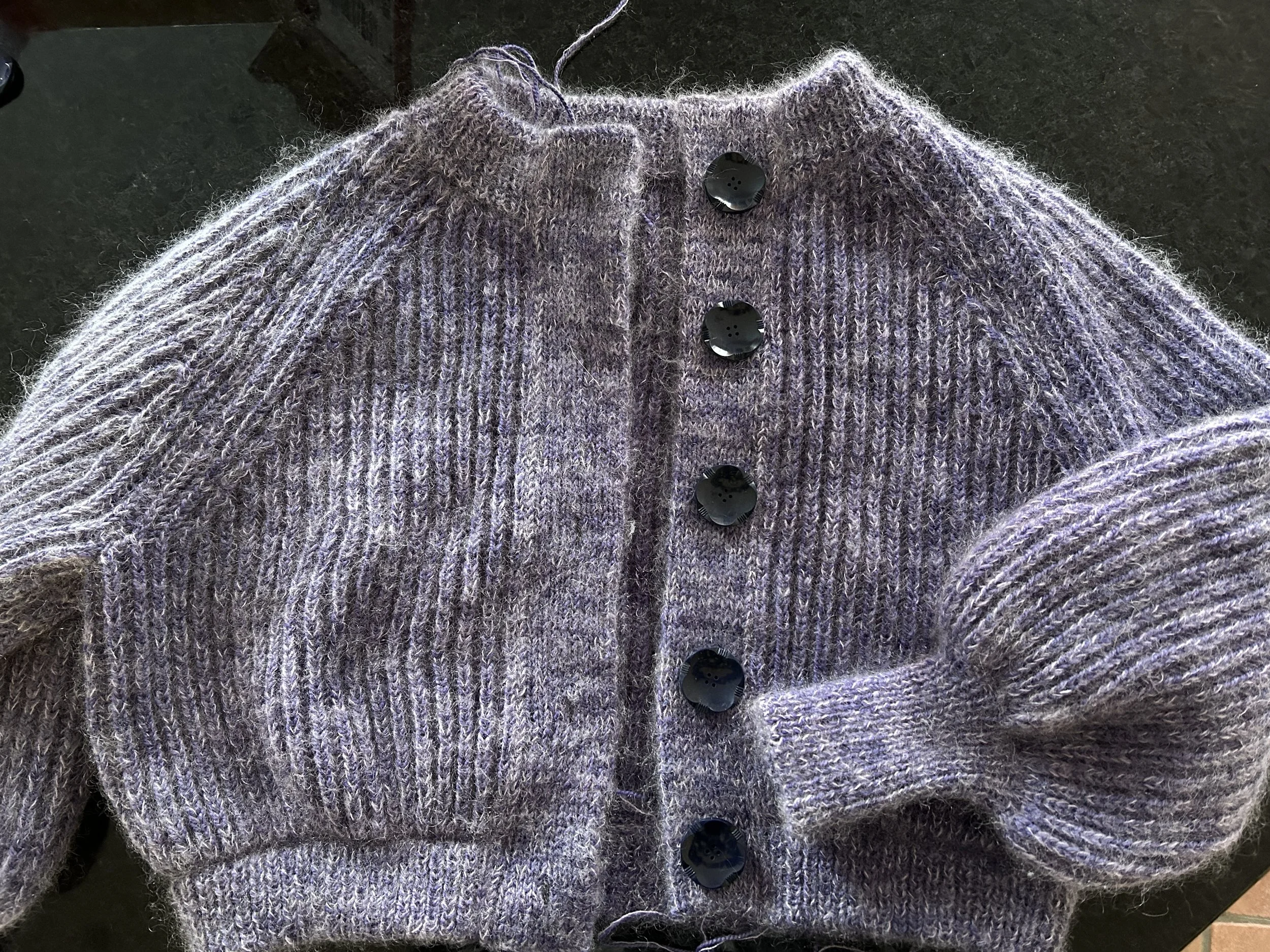
Still need weaving in ends…